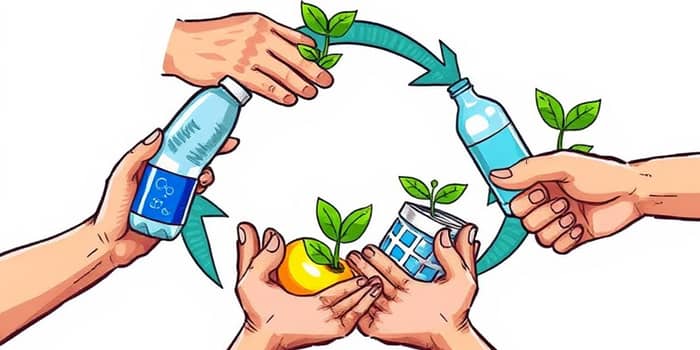
In a world where environmental degradation threatens our future, a profound shift is underway.
The old linear model of take-make-dispose is no longer viable, leading to resource depletion and pollution.
Instead, the circular economy offers a transformative and sustainable alternative that promises economic growth and ecological balance.
By investing in recycling and sustainability, we can unlock immense potential for innovation, job creation, and a healthier planet.
This article explores how embracing this change can lead to a brighter, more resilient future for all.
The circular economy is fundamentally different from the traditional linear approach.
It is built on three core pillars: eliminating waste and pollution, circulating products and materials, and regenerating natural systems.
This model ensures that resources are kept in use for as long as possible, extracting maximum value before recovering and regenerating them.
In contrast, the linear economy relies on finite resources, contributing to deforestation, climate change, and massive waste generation.
For instance, the European Union produces more than 2,100 million tons of waste annually, highlighting the urgent need for change.
Transitioning to a circular economy could generate an additional 0.5% of GDP in the EU, proving its economic viability.
At the heart of the circular economy lie the principles of reduce, reuse, and recycle, often called the three Rs.
Recycling should be the last resort, as reusing materials often saves more energy and resources.
For example, recycling six aluminum cans can offset emissions equivalent to a car's exhaust for 10 minutes.
This approach not only conserves resources but also fosters a culture of responsibility across generations.
Investing in recycling and sustainability yields significant advantages for businesses and society.
Materials like recycled paper, plastic, and glass use less energy than new raw materials.
Moreover, this model enhances corporate reputation and attracts environmentally conscious consumers.
The social impact is also profound, with recycling serving as a tool for active aging and community engagement.
Real-world examples demonstrate the practical application and success of circular economy principles.
In Spain, the PERTE for Circular Economy focuses on sectors like textiles, plastics, and renewables.
These cases show how businesses can thrive while contributing to sustainability goals.
Intergenerational recycling programs in senior centers foster community bonds and environmental stewardship.
The landscape for investing in recycling and sustainability is rich with opportunities, driven by supportive policies.
These policies encourage digitalization, eco-design, and improved waste management.
Investors can tap into sectors like renewable materials and waste-to-resource technologies.
By aligning with regulatory frameworks, businesses can mitigate risks and capitalize on growth areas.
Looking ahead to 2026, several trends and challenges will shape the future of sustainability.
Industries must conduct regular audits and adopt circular KPIs to stay competitive.
Reducing dependence on external raw materials is crucial for economic resilience.
Innovation in secondary markets will be key to transforming waste into valuable resources.
To engage effectively in this transformation, investors should consider actionable steps.
By focusing on long-term value creation, investors can drive positive change and secure returns.
Collaborating with governments and NGOs can amplify impact and access funding opportunities.
Embrace the power of transformation to build a legacy of sustainability and prosperity.
Referencias